Cat coat colors and patterns: how to identify a mixed-breed cat
Tabby, tuxedo, calico and tortoiseshell describe a coat, not a breed. Patterns such as tuxedo and torbie appear in mixed-breed cats and in pedigreed breeds.
This guide shows you how to name what you see and explains the genetics behind each pattern. Sources are linked throughout.
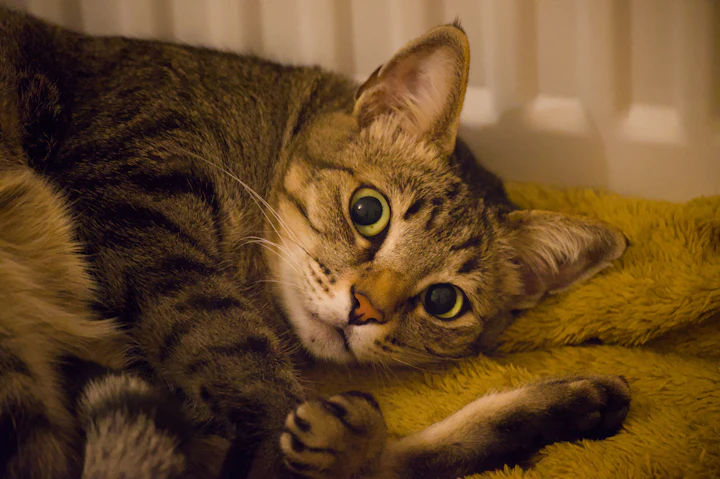
Pattern by pattern
Classic (blotched) tabby
Swirls and a circle on each side, a butterfly shape over the shoulders, thick lines down the spine and an "M" on the forehead.
- Classic (blotched) is recessive to mackerel; the difference lies in the Taqpep gene (Science, 2012).
- CFA lists the classic tabby and the blotched tabby as the same pattern.
Often confused with: Mackerel tabby – look for swirls and a side circle instead of narrow parallel stripes.
Mackerel tabby
Narrow parallel stripes that run from the spine to the belly, thinner spine lines than a classic tabby and an "M" on the forehead.
- CFA calls mackerel the most common tabby pattern.
- Mackerel is dominant to classic (blotched) at the Taqpep gene (Science, 2012).
Often confused with: Spotted tabby – in a spotted coat the stripes are broken into separate spots.
Spotted tabby
Spots in place of lines, including spotted spine lines; the layout resembles a mackerel or classic pattern broken into spots.
- CFA describes the spotted tabby as a mackerel or classic pattern whose stripes or swirls appear broken into spots.
- Like every tabby type, it carries an "M" on the forehead (CFA).
Often confused with: Mackerel tabby with interrupted stripes.
Ticked tabby
An even coat that does not look obviously striped: bands of light and dark on each hair, plus bars on the legs and tail.
- The Dkk4 gene is mutated in cats with the ticked pattern (Nature Communications, 2021).
- Agouti banding switches each hair between black and red pigment as it grows (UC Davis VGL).
Often confused with: Solid cat – check each hair for bands and the legs and tail for bars.
Solid
One color over the whole coat, with no tabby pattern and no white spots.
- Two copies of the recessive non-agouti variant (a/a) give hairs of uniform color. The tabby pattern is still present but not visible (UC Davis VGL).
- Faint tabby patterns occasionally show under certain lighting in non-agouti cats, especially in kittens with the dilute variant (UC Davis VGL).
- A solid white coat comes from dominant white in the KIT gene, which has complete penetrance for absence of coat pigmentation (G3, 2014).
- Dominant white masks the cat's other color genes (CFA).
Often confused with: Very dark tabby – a tabby keeps the forehead "M", leg bars and tail rings.
Bicolor
Solid areas of white together with one other color or pattern.
- White spotting comes from a full retrovirus insertion in the KIT gene and is dominant, so one copy is enough (UC Davis VGL).
- The gene or genes that control the layout of the white remain unknown (UC Davis VGL).
Often confused with: Calico – white with both black and red areas is calico.
Tuxedo
A solid black coat with white on the throat, chest, belly and paws.
- Tuxedo is a description of a black-and-white bicolor pattern, not a breed (Cats.com).
- Cats.com attributes the bicolor pattern to the white spotting gene, which UC Davis VGL places in the KIT gene.
Often confused with: Van – a van cat has more white than color.
Van
A bicolor cat with more white than color.
- CFA calls a bicolor cat with more white than color a bi-color van.
- The amount of white is not definitively tied to one or two copies of the white spotting variant (UC Davis VGL).
Often confused with: Solid white – a dominant white cat has no colored areas at all.
Tortoiseshell
A black, chocolate or seal coat with patches of red throughout.
- The mix of orange and non-orange patches is a mosaic created by X inactivation in females (Genetics, 2009).
- Orange is caused by a 5-kb deletion that switches on the Arhgap36 gene in pigment cells (Current Biology, 2025).
Often confused with: Calico (white with large solid areas of color) and torbie (a tabby with red or cream patches).
Calico
White with large solid areas of black and red; dilute versions are blue and cream or lilac and cream.
- Nearly all calico cats are female because the orange variant sits on only one of their two X chromosomes (NPR).
- Vetstreet cites a University of Missouri study that puts males at one in 3,000 calicos.
Often confused with: Tortoiseshell (no white) and bicolor (white with a single color).
Torbie (patched tabby)
A brown, silver or blue tabby with patches of red or cream scattered through the tabby pattern.
- CFA names this coat a patched tabby; any of the four tabby patterns can combine with red or cream.
- Cats.com describes torbie as a type of patched tabby and as a pattern, not a breed.
- A UC Davis owner survey grouped torbies with tortoiseshells and calicos as sex-linked orange females (Journal of Applied Animal Welfare Science, 2016).
Often confused with: Tortoiseshell – a torbie shows a tabby pattern; CFA defines a tortoiseshell as black, chocolate or seal with red patches.
Colorpoint
A pale body with color only at the extremities – the face, ears, feet and tail.
- Variants in the TYR gene make pigment production temperature-sensitive. Pigment is reduced in warmer areas and darker at the cooler extremities (UC Davis VGL).
- Siamese kittens are born white and dark hues begin at about two weeks (National Geographic).
- Siamese-type points come with blue eyes; Burmese-type cats have yellow-gray or yellow-green eyes (UC Davis VGL).
Often confused with: Bicolor – points are darker fur on a pale body, not white patches on a colored coat.
Blue (dilute black)
A gray coat; "blue" is the term cat breeders use for gray.
- Two copies of a recessive MLPH variant clump pigment granules in the hair and dilute black to gray (UC Davis VGL).
- Chartreux, Korat and Russian Blue are breeds fixed for dilute (UC Davis VGL).
Often confused with: Lilac – lilac is the dilute of chocolate, not of black.
Cream (dilute orange)
The diluted, paler form of an orange (red) coat.
- The dilute variant turns red (orange) into cream (UC Davis VGL).
- A sex-linked orange cat shows the tabby pattern whether or not it is non-agouti (UC Davis VGL).
Often confused with: Pale orange tabby.
Lilac (dilute chocolate)
The diluted form of a chocolate coat.
- Chocolate is diluted to lilac when a cat has two copies of the dilute allele (Langford Vets).
- Chocolate comes from a recessive variant of the TYRP1 gene that reduces black pigment (UC Davis VGL).
Often confused with: Blue.
Common claims, checked
Every tabby has an "M" on the forehead
TrueAll tabby patterns – classic, mackerel, spotted and ticked – carry an "M" on the forehead, according to the Cat Fanciers' Association. Source
About 80% of orange cats are male
Mostly trueAbout 80% of orange cats are male, as NPR reported alongside the 2025 Current Biology studies. NPR gives the figure as approximate. A male needs the orange variant on his single X chromosome; a female needs it on both to be fully orange. Source
Calico and tortoiseshell cats are almost always female
TrueNearly all calico and tortoiseshell cats are female. Vetstreet cites a University of Missouri study putting males at one in 3,000 calicos. A UK veterinary survey recorded 20 tortoiseshells among 4,598 male cats (0.43% of males). Of 11 that were tested, two were XXY and six had both XX and XY cells. Source
Colorpoint color is temperature-sensitive and Siamese kittens are born white
TrueVariants in the TYR gene make pigment production temperature-sensitive, so the cooler extremities darken (UC Davis VGL). Siamese kittens are born white and dark hues begin at about two weeks (National Geographic). Source
Colorpoint cats have blue eyes
Mostly trueSiamese-type colorpoint cats have blue eyes. Burmese-type (sepia) cats have yellow-gray or yellow-green eyes, and mink cats are intermediate in color between the two. Source
A dominant white coat hides the cat's other colors
TrueDominant white, a variant in the KIT gene, has complete penetrance for absence of coat pigmentation (G3, 2014). CFA describes it as masking all other color genes. One copy is enough (UC Davis VGL). Source
All orange cats show tabby markings
TrueA sex-linked orange cat shows the tabby pattern whether it is agouti or non-agouti, because non-agouti does not mask the pattern in orange hair. Source
Coat pattern does not predict personality
Mostly trueA 189-person UC Berkeley survey found that people assign traits to colors, and its lead author noted little evidence the differences exist. A UC Davis survey analyzed 1,274 owner responses. Owners reported more frequent aggression toward people in tortoiseshell, calico, torbie, black-and-white and gray-and-white cats. Source
Start with five checks
- Stripes, swirls, spots or banded hairs: tabby.
- One even color with no markings and no white: solid.
- White plus one other color or pattern: bicolor.
- Black and orange together: tortoiseshell. Add white for calico. Add stripes for torbie.
- Color only on the face, ears, feet and tail: colorpoint.
Then check the shade. Gray, cream and lilac are diluted versions of black, orange and chocolate.
Tabby: classic, mackerel, spotted and ticked
The Cat Fanciers' Association (CFA) describes four tabby types and calls mackerel the most common.
| Type | What you see | Source |
|---|---|---|
| Classic (blotched) | Swirls and a circle on each side, with a butterfly shape over the shoulders | CFA |
| Mackerel | Narrow parallel stripes that run from the spine to the belly | CFA, CFA for Kids |
| Spotted | Stripes or swirls broken into spots | CFA |
| Ticked | Bands of light and dark on each hair, with bars on the legs and tail | CFA, CFA for Kids |
All four carry an "M" on the forehead, according to CFA. CFA also lists necklaces on the neck, bars on the legs and rings on the tail.
One gene, Taqpep, separates mackerel from classic, and mackerel is dominant (Science, 2012). The ticked pattern traces to a second gene, Dkk4 (Nature Communications, 2021).
Common confusion: a very dark tabby and a solid cat. Look for the forehead "M", leg bars and tail rings.
Solid
A solid cat has one color, no tabby pattern and no white spots (CFA). The cause is two copies of the recessive non-agouti variant, which gives each hair one even color (UC Davis Veterinary Genetics Laboratory).
The tabby pattern is still present, just not visible. Faint tabby markings occasionally show under certain lighting, especially in kittens with the dilute variant (UC Davis).
Solid white works differently. Dominant white, a variant in the KIT gene, removes coat pigment (G3, 2014). It masks the cat's other color genes (CFA).
Bicolor, tuxedo and van
A bicolor cat has solid areas of white plus another color or pattern (CFA). Tuxedo describes a black coat with white on the throat, chest, belly and paws (Cats.com). Van is CFA's term for a bicolor cat with more white than color.
White spotting is dominant, so one copy of the KIT variant is enough. The genes that decide where the white lands are still unknown (UC Davis).
Common confusion: white with both black and orange is calico, not bicolor.
Tortoiseshell, calico and torbie
- Tortoiseshell: black, chocolate or seal with patches of red throughout the coat.
- Calico: white with large solid areas of black and red.
- Torbie (patched tabby): a tabby with patches of red or cream.
The definitions are CFA's. CFA uses the name patched tabby, and Cats.com describes torbie as a type of patched tabby.
All three need the orange variant on one X chromosome and not on the other. Each skin patch uses one X or the other, which creates the mosaic (Genetics, 2009). In 2025, researchers traced orange to a deletion that switches on the Arhgap36 gene in pigment cells (Current Biology).
That takes two X chromosomes, so nearly all of these cats are female (NPR). Vetstreet cites a University of Missouri figure of one male per 3,000 calicos. A UK veterinary survey recorded 20 tortoiseshells among 4,598 male cats, or 0.43%.
Orange (red or ginger)
An orange cat shows the tabby pattern whether or not it carries the solid-color variant (UC Davis).
About 80% of orange cats are male, NPR reported alongside the 2025 studies. A male needs the variant on his single X. A female needs it on both to be fully orange.
Colorpoint
A colorpoint cat carries its color at the extremities – the face, ears, feet and tail (CFA). Variants in the tyrosinase (TYR) gene make pigment production temperature-sensitive. Pigment is reduced in warmer areas, and the cooler extremities darken (UC Davis).
Siamese kittens are born white. Dark hues start to appear at about two weeks, and the fur darkens as the cat ages (National Geographic).
Siamese-type points come with blue eyes. Burmese-type (sepia) cats have more body color and yellow-gray or yellow-green eyes (UC Davis). Points can also carry tabby markings, called lynx point (UC Davis).
Common confusion: points alone do not name a breed. The trait is recessive, and two full-colored carriers can produce a pointed kitten (UC Davis).
Dilute colors: blue, cream and lilac
Dilute colors are paler versions of the full colors. Two copies of a recessive variant in the MLPH gene clump the pigment granules in each hair (UC Davis).
| Full color | Dilute | Source |
|---|---|---|
| Black | Blue (gray) | UC Davis |
| Orange (red) | Cream | UC Davis |
| Chocolate | Lilac | Langford Vets |
Dilution affects all coat colors (UC Davis). A blue cat with cream patches is a blue-cream, and calico also comes in blue and cream (CFA).
Common confusion: "blue" is the term cat breeders use for gray.
Coat color and personality
Coat color is a poor guide to temperament. In a UC Berkeley survey of 189 people, respondents rated orange cats as friendly, white cats as aloof and tortoiseshells as intolerant. The lead author noted little evidence that those differences exist.
A UC Davis survey analyzed 1,274 responses from cat owners. They reported more frequent aggression toward people in tortoiseshell, calico, torbie, black-and-white and gray-and-white cats. The data were owner reports. Aggression during handling and veterinary visits showed little difference among colors.
Get to know the cat in front of you rather than judging by coat color.
Questions
Is a tabby cat a breed?
No. The Cat Fanciers' Association describes tabby as a pattern, not a color and not a breed.
Are all orange cats male?
No. About 80% are male, according to NPR's report on the 2025 studies. A female is fully orange when both of her X chromosomes carry the orange variant.
Can a male cat be calico or tortoiseshell?
Yes, but rarely. Of 11 such males tested in a UK study, two were XXY and six carried both XX and XY cells. Vetstreet notes that XXY males are usually sterile.
Why do Siamese-type kittens change color?
Pigment production is reduced in warmer areas of the body. Siamese kittens are born white, and the cooler face, ears, feet and tail darken as they grow.
Does a white cat have a hidden color?
Yes. Dominant white masks the cat's other color genes, so the coat alone cannot tell you what is underneath.
Sources
- Feline Coat Color – UC Davis Veterinary Genetics Laboratory
- Agouti (cat DNA test) – UC Davis Veterinary Genetics Laboratory
- Colorpoint Restriction – UC Davis Veterinary Genetics Laboratory
- Dominant White & White Spotting – UC Davis Veterinary Genetics Laboratory
- Dilute (cat DNA test) – UC Davis Veterinary Genetics Laboratory
- Brown (Chocolate and Cinnamon) – UC Davis Veterinary Genetics Laboratory
- Dilute Coat Colour – Langford Vets, University of Bristol
- What is a Pattern on a Cat? – The Cat Fanciers' Association
- Coat & Color Descriptions – The Cat Fanciers' Association
- Colors and Patterns: An Introduction to Color Genetics in the Pedigreed Cat – The Cat Fanciers' Association
- Ask Elizabeth: White Cats and Blindness/Deafness – Cornell Feline Health Center
- Specifying and Sustaining Pigmentation Patterns in Domestic and Wild Cats – Science (2012)
- Developmental genetics of color pattern establishment in cats – Nature Communications (2021)
- A Domestic cat X Chromosome Linkage Map and the Sex-Linked orange Locus – Genetics (2009)
- Molecular and genetic characterization of sex-linked orange coat color in the domestic cat – Current Biology (2025)
- Endogenous Retrovirus Insertion in the KIT Oncogene Determines White and White Spotting in Domestic Cats – G3: Genes, Genomes, Genetics (2014)
- Male tortoiseshell cats in the United Kingdom – Veterinary Record (1999)
- The DNA secret behind orange cats – NPR Short Wave
- Can Calico Cats Be Male? – Vetstreet
- How Siamese cats change their colors – National Geographic
- The Relationship Between Coat Color and Aggressive Behaviors in the Domestic Cat – Journal of Applied Animal Welfare Science (2016)
- Don't be so fast to judge a cat by its color, study warns – UC Berkeley News
- All About Tuxedo Cats – Cats.com
- 5 Facts About Torbie Cats You Probably Did Not Know – Cats.com