Hot asphalt and your dog's paws
Asphalt in direct sun runs far hotter than the air above it. On a 77°F (25°C) day it can reach 125°F (52°C). Washington State University notes that human skin can be destroyed in 60 seconds at that temperature.
This guide gives the sourced temperature figures, the seven-second hand test, the signs of burned paw pads, and what to do next. Not a substitute for professional veterinary help.

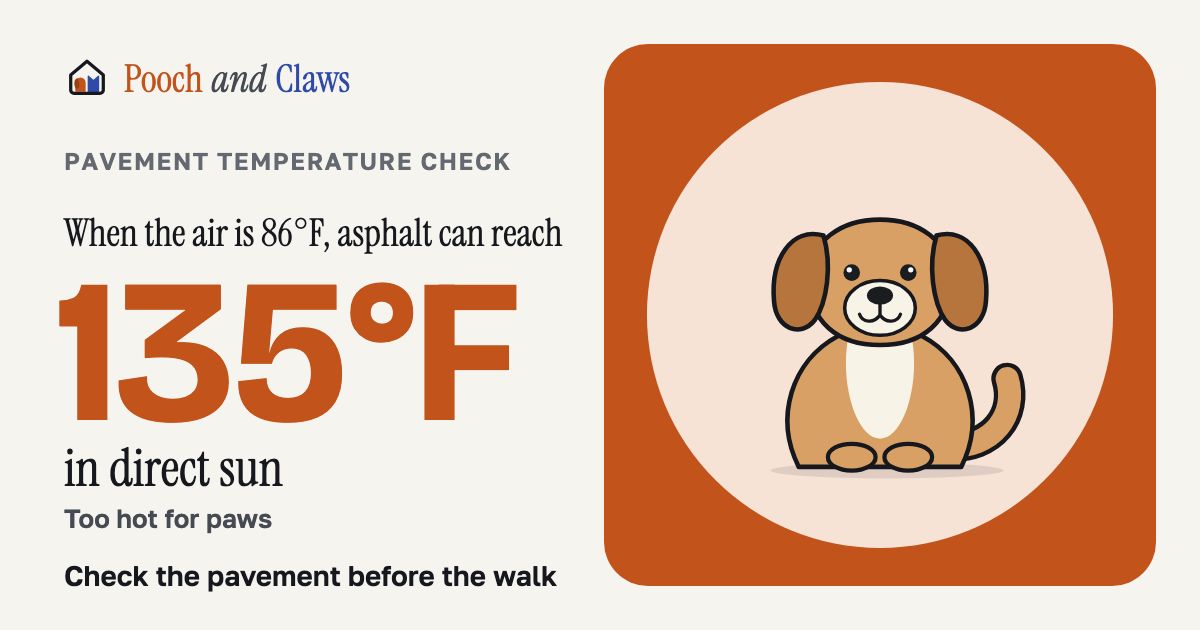
Pavement temperature check
135°F on asphalt in direct sun
Too hot for paws
Keep your dog off the pavement. Walk on grass, wait for early morning or evening, or use well-fitted dog boots.
Share this result
How hot asphalt gets
The three readings below come from Washington State University's College of Veterinary Medicine. It attributes them to a 1970 paper by James Berens in the Journal of the American Medical Association (JAMA). It gives the conditions for the 77°F reading as direct sunlight and no wind.
| Air temperature | Asphalt temperature |
|---|---|
| 77°F (25°C) | 125°F (52°C) |
| 86°F (30°C) | 135°F (57°C) |
| 87°F (31°C) | 143°F (62°C) |
The paper, Thermal Contact Burns From Streets and Highways, studied accident victims burned by contact with summer highway pavement. A later burn-care study reports that Berens took readings in Phoenix, Arizona, in 1966–1967. He measured asphalt as high as 172°F (78°C) and concrete up to 156°F (69°C).
The American Kennel Club (AKC) cites the same journal for the 86°F reading. It advises that at 85°F (29°C) or more, pavement with no chance to cool may be too hot for a safe walk.
How fast hot pavement burns skin
Burn risk depends on surface temperature and contact time. A medical review of pavement contact burns lists thresholds for a second-degree contact burn, taken from 1947 research.
| Surface temperature | Contact time to a second-degree burn |
|---|---|
| 111°F (44°C) | 6 hours |
| 122°F (50°C) | 15 minutes |
| 140°F (60°C) | 5 seconds |
| 149°F (65°C) | 2 seconds |
Washington State University gives a faster figure for black pavement: human skin destruction in 60 seconds at 125°F (52°C). It also cites a 1995 report on summer pavement in Maricopa County, Arizona. On most days, second-degree burns could result within 35 seconds of contact between 10 a.m. and 5 p.m.
The seven-second hand test
Press the back of your hand against the pavement. If you cannot hold it there for a full seven seconds, it is too hot for your dog's paws. Washington State University and the Royal Kennel Club both describe the test this way.
The AKC gives a ten-second version: place your hand comfortably on the pavement for ten seconds. It says a bare foot works as well, and that the test applies to sand, metal, and concrete.
Test the stretch your dog will walk on. The Royal Kennel Club notes that direct sunlight, wind, and humidity all influence pavement temperature. It says the weather alone makes it difficult to know how hot the pavement is.
Asphalt, concrete, sand, turf, and grass
| Surface | What the sources report |
|---|---|
| Asphalt | Peaked near 154°F (68°C) in Phoenix, Arizona, measurements published in 1995. A 2020 Las Vegas study recorded 166°F (74°C) when the air was 120°F (49°C). |
| Concrete | Cooler than asphalt, still hot enough to burn. Peaks of 136–140°F (58–60°C) in the Phoenix measurements and 144°F (62°C) in the Las Vegas study. |
| Sand | Peaked alongside asphalt near 154°F (68°C) in the Phoenix measurements. The Las Vegas study recorded 143°F (62°C). |
| Metal | Steel peaked at 136–140°F (58–60°C) in the Phoenix measurements. Washington State University warns against pickup truck beds. |
| Artificial turf | A UNLV and Desert Research Institute study measured green artificial turf about 69°F hotter than irrigated natural grass. The maximum was 169°F (76°C). |
| Natural grass | The cooler choice. Washington State University, the AKC, and the Royal Kennel Club all advise walking on grass. |
| Shaded pavement | Shade cut the asphalt peak to 109°F (43°C) and the cement peak to 102°F (39°C) in the Phoenix measurements. |
Signs of burned paw pads
- Limping, holding a paw abnormally, or refusing to walk
- Licking or chewing at the feet
- Pads that look red, swollen, or darker than usual
- Blisters, peeling skin, or a missing top layer of pad
- Bleeding or ulcerated pads, or crying out when using the leg
Signs can be delayed. Washington State University notes that lesions take time to develop after the burn. PetMD adds that blisters can fill with fluid and rupture a few days after exposure. Examine the pads closely after walks in hot weather.
First aid for burned paws
- Move your dog off the hot surface and onto grass or into shade.
- Run cool, not cold, tap water over the paws. The AKC's burn-care guidance gives 15 to 20 minutes.
- If you use a garden hose, let it run until the water is cool. The AKC notes that water sitting in a hose on hot days can be scalding.
- Skip the ice. The AKC warns it can constrict blood vessels and worsen the injury.
- Do not apply human creams, home remedies, soap, or peroxide.
- Lay a sterile, non-stick dressing over the pad to keep it clean. Cover it without wrapping, and do not bandage it yourself.
- Call your veterinarian. Washington State University advises that any suspected pad burn be seen as soon as possible.
Veterinary care for pad burns can include pain relief, wound cleaning and dressing, antibiotics, and a cone to stop licking. PetMD puts healing at 7 to 10 days for mild injuries and weeks for severe burns.
How to prevent paw burns
- Walk early or late. Choose early morning or evening and avoid the midday sun.
- Pick the surface. Choose grass, soil, and shade over pavement and artificial turf.
- Do the hand test before every summer walk.
- Use dog boots. The AKC says the fit should be snug, not too tight and not too loose. PetMD lists breathable fabric and nonslip soles. Browse dog boots on Chewy or on Amazon.
- Know the limits of paw wax. The AKC notes that paw products moisturize pads and help prevent cracking. PetMD cautions that wax may not prevent burns on the hottest days.
- Condition the pads. The AKC suggests walking on pavement in cool weather to toughen them.
- Never tether your dog on hot pavement or in a pickup truck bed.
When to call a veterinarian
Call your veterinarian as soon as you suspect a pad burn. PetMD states that a severe burn needs a veterinarian immediately and that pad burns can become infected quickly. Do not wait if you see any of the following.
- Red, swollen, or blistered pads
- Bleeding, peeling, or missing pad tissue
- A wound that is not visibly improving after a few days
- A dog that seems uncomfortable or stops eating
Questions
At what temperature is pavement too hot for dogs?
The AKC advises that at 85°F (29°C) or more, pavement with no chance to cool may be too hot. Asphalt can reach 125°F (52°C) on a 77°F (25°C) day in direct sun. Use the hand test on the actual surface before you walk.
How long does it take for hot pavement to burn a dog's paws?
Published burn times describe human skin. Washington State University states that skin destruction can occur in 60 seconds at 125°F (52°C). Burn research puts a second-degree burn at 5 seconds at 140°F (60°C).
Is concrete cooler than asphalt for dogs?
Concrete ran cooler than asphalt in the published measurements. It still reached 136–144°F (58–62°C) in direct sun, which is hot enough to burn. Test concrete the same way you test asphalt.
Do dog boots or paw wax protect against hot pavement?
PetMD says dog boots can lower the risk of pad injury on hot surfaces. It cautions that paw wax may not prevent burns on the hottest days. Walk at cooler times of day as well.
Is artificial turf safe for dogs in summer?
Artificial turf gets very hot in sun. A UNLV and Desert Research Institute study recorded turf surfaces up to 169°F (76°C), about 69°F hotter than irrigated natural grass. Do the hand test on turf as well.
Sources
- Protect your pet's feet from heat, burns – Washington State University, College of Veterinary Medicine
- Thermal Contact Burns From Streets and Highways – JAMA
- "Streets of Fire" revisited: contact burns – Burns & Trauma, via PubMed Central
- Temperature Profiles of Sunlight-Exposed Surfaces in a Desert Climate: Determining the Risk for Pavement Burns – Journal of Burn Care & Research, via PubMed Central
- How Hot Is Too Hot for a Dog's Paws? – American Kennel Club
- Caring for Dog Burns: Everything You Need to Know – American Kennel Club
- Hot pavements – The Royal Kennel Club
- Hot Weather Safety Tips – ASPCA
- Paw Pad Burns on Dogs: What to Do – PetMD
- How to Protect Dog Paws in Summer – PetMD
- Burned Paw Pads in Dogs – Vetster
- Study Finds Artificial Turf May be Too Hot for Summer Use – University of Nevada, Las Vegas
- How to walk your dog when the pavement is hot – Scripps News